Reading Time: Approximately 10 minutes
Summarize with:





Choosing the wrong commercial steam kettle doesn’t just mean wasting money on equipment—it means sacrificing food safety, straining already-stretched labor budgets, and risking kitchen shutdowns during critical service periods. Yet most equipment buying guides treat institutional kitchens like oversized restaurants, ignoring the unique pressures of feeding hundreds or thousands daily while maintaining HACCP compliance and managing bond-funded capital budgets.
If you’re managing a school district kitchen, hospital foodservice operation, university dining hall, or large-scale catering facility, this guide was built specifically for you. Over the following sections, you’ll discover how to avoid the three most costly capacity-planning mistakes, decode NSF compliance requirements that manufacturers gloss over, and calculate real ROI that justifies equipment purchases to your finance committee.
This isn’t a manufacturer’s sales pitch—it’s a data-driven framework that helps you select equipment based on your actual production workflows, compliance requirements, and long-term cost of ownership.
Key Takeaways
- Capacity underestimation is your costliest mistake: Use the formula [DailyServings]÷[BatchYieldperGallon]×1.2Buffer=MinimumCapacity to avoid upgrading within 5 years.
- NSF/ANSI 4 certification is mandatory, but 316 stainless steel isn’t enough: Verify accessible drain ports, self-lubricating gear systems, and temperature logging to prevent biofilm contamination and unplanned downtime.
- Gas and steam-jacketed models deliver measurable savings: ENERGY STAR certified electric models save approximately $820 annually; gas models save $780 annually, with lifetime savings reaching $6,200–$7,100.
- Tilt mechanisms reduce labor by 8–11 hours weekly in high-volume operations, but they’re only cost-effective for specific recipes (sauces, braising, pasta—not soups).
- Preventive maintenance costs 50% less than emergency repairs: Stock removable gaskets and pressure relief valves as spare parts; plan replacements during off-peak periods.
Step 1: Mapping Kettle Capacity to Your Batch Production Needs
The single most expensive mistake institutional kitchen directors make is purchasing a kettle too small for their actual serving volume. Unlike restaurants that can adjust menu items or reduce portions during peak periods, schools and hospitals operate within fixed meal windows and student/patient population commitments.
The Capacity Formula for Institutional Kitchens
Start with this proven calculation:
Minimum Kettle Capacity = [Daily Servings] ÷ [Batch Yield per Gallon] × 1.2 Buffer
Let’s apply this to a real example: a school district serving 750 students lunch. If your chili recipe yields 15 portions per gallon and you need to produce three batches during the two-hour lunch window:
- Daily servings: 750 students
- Yield per gallon: 15 portions per gallon = 50 gallons required for full volume
- Buffer for holdover, waste, and seconds: 50 × 1.2 = 60-gallon minimum capacity
This 20% buffer isn’t optional in institutional settings. Here’s why: if your kettle reaches 2/3 capacity (40 gallons in a 60-gallon model), the steam jacket maintains even temperature distribution. Fill it beyond 2/3 capacity, and you risk temperature dead zones where food doesn’t reach safe holding temperatures—a direct HACCP violation. Conversely, operating a 40-gallon kettle at full capacity requires two batches instead of one, adding 45–60 minutes to your production timeline.
Why Schools & Hospitals Require Larger Buffers Than Restaurants
Institutional operations face variability that commercial restaurants don’t. A hospital kitchen must accommodate patient meal changes that occur as late as 6:00 AM—meaning your 5:00 AM production batch must have overflow capacity. School districts face similar pressure: a field trip cancellation frees up 100 meals, but you’ve already produced them. A 20% capacity buffer absorbs these swings without forcing menu compromises or skip-cooking.
Additionally, NSF-mandated hot holding times increase the practical batch sizes. If your soup must be held at 160°F for up to 2 hours before service, you’re not simply cooking a single batch—you’re cooking a batch and then managing temperature maintenance for the duration of the serving window.
Real-world example from a 500-student district kitchen director: “We initially purchased a 40-gallon kettle thinking it matched our production. But NSF hold-time requirements and mid-day menu adjustments meant we were running three batches for breakfast and lunch combined. We upgraded to a 60-gallon model after 18 months. That mistake cost us $15,000 in downtime and expedited purchase fees.”
Red Flags: When Your Kettle is Undersized
Watch for these operational signals that your equipment capacity is inadequate:
- Kettle fill regularly exceeds 2/3 capacity during normal production: Your equipment is operating outside safe thermal parameters.
- Staff regularly uses secondary kettles or stock pots as backup: You’re essentially running a patchwork system that defeats the purpose of invested capital.
- Menu flexibility decreases due to production time constraints: You’re forcing the kitchen to cook the same items repeatedly because scaled batches take too long.
- Holdover temperatures fluctuate by more than 5°F during service hours: Under-sized kettles struggle with heat recovery after repeated serving.
Institutional Compliance: 5 Non-Negotiable Steam Kettle Features
Compliance isn’t just a checkbox—it’s the operational foundation that determines whether your kitchen passes inspections, maintains accreditation, and avoids costly shutdowns. For schools and hospitals, NSF/ANSI 4 certification and NSF/ANSI 51 materials standards are legally mandated, not optional upgrades.
NSF/ANSI 4 & 29 Certified Construction: More Than Just a Label
NSF/ANSI 4 establishes minimum food protection and sanitation requirements for commercial cooking equipment, including kettles, steamers, and pressure cookers. NSF/ANSI 29 specifically governs chemical feeders and sanitizer systems on dishwashing equipment—which directly impacts your post-use kettle sanitation protocols.
Here’s what NSF/ANSI 4 compliance actually requires:
- Smooth, non-porous food-contact surfaces that prevent bacterial harborage (304 or 316 stainless steel meets this; painted finishes or unsealed materials do not)
- Disassemblable components that allow staff to access all internal surfaces for cleaning without tools
- Self-draining design where all internal angles are sloped at minimum 1:4 (14 degrees) to prevent standing water
- Accessible drain ports that can be cleaned and sanitized without removing the entire unit
The critical distinction: NSF certification doesn’t mean “good enough”—it means the manufacturer has submitted the design for testing and claims compliance. During your procurement process, always request the NSF Certificate number and verify it directly on the NSF International website. Counterfeit or lapsed certifications do exist in secondary equipment markets.
Why 316 Stainless Steel Isn’t Enough (And What Actually Matters)
Steel grade alone doesn’t determine compliance or longevity. Many low-cost kettles use 304 stainless steel in food zones but inferior materials in non-food zones—creating corrosion pathways that compromise structural integrity. Grade 316 stainless steel, which adds molybdenum for chloride resistance, is the institutional standard, but it only matters if the entire kettle body and jacket use it.
Look for these specific material specifications:
| Component | Compliant Material | Why It Matters |
|---|---|---|
| Kettle liner | 316 stainless steel, seamless deep-drawn | Prevents pitting from acidic foods and chlorinated cleaning agents |
| Jacket (steam side) | 316 stainless steel, seam-welded | Withstands repeated pressure cycling (30–50 PSI typical) without degradation |
| Gaskets/seals | FDA-compliant elastomer (EPDM or silicone) | Food-grade materials prevent chemical leeching and degradation |
| Drain valve | 316 stainless steel, self-closing design | Prevents biofilm accumulation in dead-leg drain lines |
HACCP-Compatible Temperature Logging: ±2°F vs. ±7°F
Institutional kitchens must maintain HACCP documentation showing that hot foods held in steam kettles remain at or above 160°F throughout the service period. Manual thermometer checks (the way many kitchens still operate) introduce human error and create liability if documentation is incomplete.
Precision matters here. A kettle with ±7°F temperature variance (common in budget electric models) means a 160°F setpoint might actually reach only 153°F—below the HACCP safe holding temperature. A ±2°F system (like AccuTemp Edge Series controls) maintains documented compliance with no margin for error.
For procurement specifications, require:
- Digital thermostat display readable from the operator station (not hidden behind the kettle)
- Temperature data logging capability (optional wireless, but at minimum a written log template with printed records)
- Low-temperature alarm that alerts staff if the jacketed temperature drops below your preset critical control point
- Calibration certification showing the temperature sensor was factory-calibrated to ±1°F and includes a quarterly recalibration schedule
Tip Prevention and Stability Testing: An Underrated Safety Factor
You won’t find tipping incidents in many equipment guides, but they’re surprisingly common in school kitchens where younger staff may not understand proper tilting technique. Institutional steam kettles must meet specific stability standards.
What to specify:
- Base width-to-height ratio: A 40-gallon kettle should have a base at least 36 inches wide. Narrow bases (under 30 inches) create tip hazards when the tilt mechanism is engaged with full capacity.
- Anti-tip legs: Adjustable feet that spread the weight distribution and prevent rocking on uneven floors (common in older school kitchens).
- Tilt locking mechanism: Mechanical stops that prevent accidental overtravel and ensure safe return to upright position.
- Clear maximum fill line: Engraved or permanently marked on the kettle interior, visible from the loading position.
Accessible Drain Ports to Prevent Biofilm Risks
This is where most commercial kettles fail institutional audits. A drain valve buried under the kettle or requiring disassembly makes deep cleaning nearly impossible. HACCP compliance demands that every square inch of food-contact surface is accessible for inspection and sanitation.
What compliance actually requires:
- Front-facing drain valve positioned 6–8 inches from the floor for easy access without moving the kettle
- Self-closing check valve that prevents backflow and bacterial colonization in the drain line
- Strainer basket that’s removable without tools and cleanable under running water
- 316 stainless steel drain body (not plastic or lower-grade steel) that resists corrosion from hot water and cleaning chemicals
Problematic designs (which you’ll see in budget models and some restaurant-focused equipment):
- Bottom drains requiring the kettle to be partially tilted to reach
- Fixed drain baskets welded in place, making biofilm removal impossible
- Plastic or rubber drain components that degrade under 160°F+ water and cleaning agents
Power Source Showdown: Electric vs. Gas vs. Direct Steam ROI Analysis
Your power source decision directly impacts your 5-year operating budget. The difference between electric and gas-jacketed kettles isn’t academic—it represents $4,800–$6,000 in cumulative utility costs for a 40-gallon unit over five years.
Energy Efficiency Benchmarks: Data-Driven Comparison
ENERGY STAR-certified commercial steam cookers deliver the most objective comparison data available. According to ENERGY STAR data, certified electric models save approximately $820 annually compared to standard electric models, while gas models save approximately $780 annually. Over a 5-year equipment lifespan, this translates to lifetime savings of $7,100 (electric) and $6,200 (gas).
For a hospital or large school district operating multiple kettles:
- Single 40-gallon kettle operating 250 days/year = $4,100 in 5-year energy costs (electric) vs. $3,900 (gas)
- Network of four kettles across a district = $16,400 potential savings with gas/steam-jacketed models
Water consumption is the overlooked factor: Steam-jacketed kettles (whether gas or electric-heated) reduce water consumption by approximately 18% compared to direct-heated models because the insulated jacket prevents rapid cooling and reduces recovery time between batches.
| Power Source | Startup Cost | Annual Energy | 5-Year Total | Maintenance | Best For |
|---|---|---|---|---|---|
| Electric, Direct | $12,000–$16,000 | $1,800 | $9,000–$18,000 | Low | Small facilities under 200 meals/day |
| Electric, Steam-Jacketed | $18,000–$24,000 | $1,400 | $7,000–$19,000 | Moderate | Mid-size schools, corporate dining |
| Gas, Steam-Jacketed | $16,000–$22,000 | $1,200 | $6,000–$17,000 | Moderate-High | Hospitals, districts with gas infrastructure |
| Direct Steam (Boiler-Fed) | $10,000–$14,000 | $600 | $3,000–$15,000 | High | Facilities with in-house steam generation |
When Electric Makes Sense (And When It’s a Budget Trap)
Despite gas’s efficiency advantage, electric is the correct choice in specific scenarios:
Electric Makes Financial Sense When:
- Your facility has no natural gas infrastructure (retrofit cost would exceed $15,000)
- You’re cooking under 300 meals/day (annual savings gap < $500, not worth infrastructure cost)
- You’re operating a satellite kitchen in a space without dedicated gas line access
- Your utility rates favor electricity heavily (rare, but it happens in some regions with abundant hydroelectric power)
Electric Becomes a Trap When:
- Your central kitchen serves 500+ meals/day but you choose electric to “save upfront costs”
- You’re retrofitting an existing gas line-equipped kitchen for budget reasons
- You’re operating in a high-electricity-cost region (Northeast, California) where gas costs 40% less per BTU
Real-world case: A 750-student school district in Pennsylvania chose a $16,000 electric kettle to avoid the $3,500 gas-line extension cost. Over 5 years, the extra $2,000/year in electric costs totaled $10,000—far exceeding the infrastructure savings. Worse, when the kettle required replacement, the next purchase needed gas compatibility anyway due to kitchen renovations.
The Exception: Tilt Skillets and Temperature-Sensitive Recipes
Tilt skillets introduce a separate efficiency calculus because their design priorities differ from traditional kettles. Where kettles maximize holding temperature stability, tilt skillets prioritize precise low-temperature control for sauces and delicate proteins.
Why tilt skillets differ: A steam-jacketed tilt skillet heats through a 2/3-height jacket, but the exposed top surface loses heat rapidly to the kitchen environment. For recipes requiring 180°F–200°F (gravies, cream sauces), this temperature loss is actually beneficial—it prevents curdling and breaking. For boiling (soups, stocks), it’s inefficient.
Gas-heated tilt skillets recover temperature 12–15% faster than electric after you introduce cold ingredients, making them preferable when you’re blanching vegetables or simmering multiple batches. But if you’re primarily making delicate sauces at low temperature, electric’s simpler temperature control (no pilot light, instant on/off) may offset the efficiency gap.
AccuTemp Edge Series: Precision Specs for High-Volume Consistency
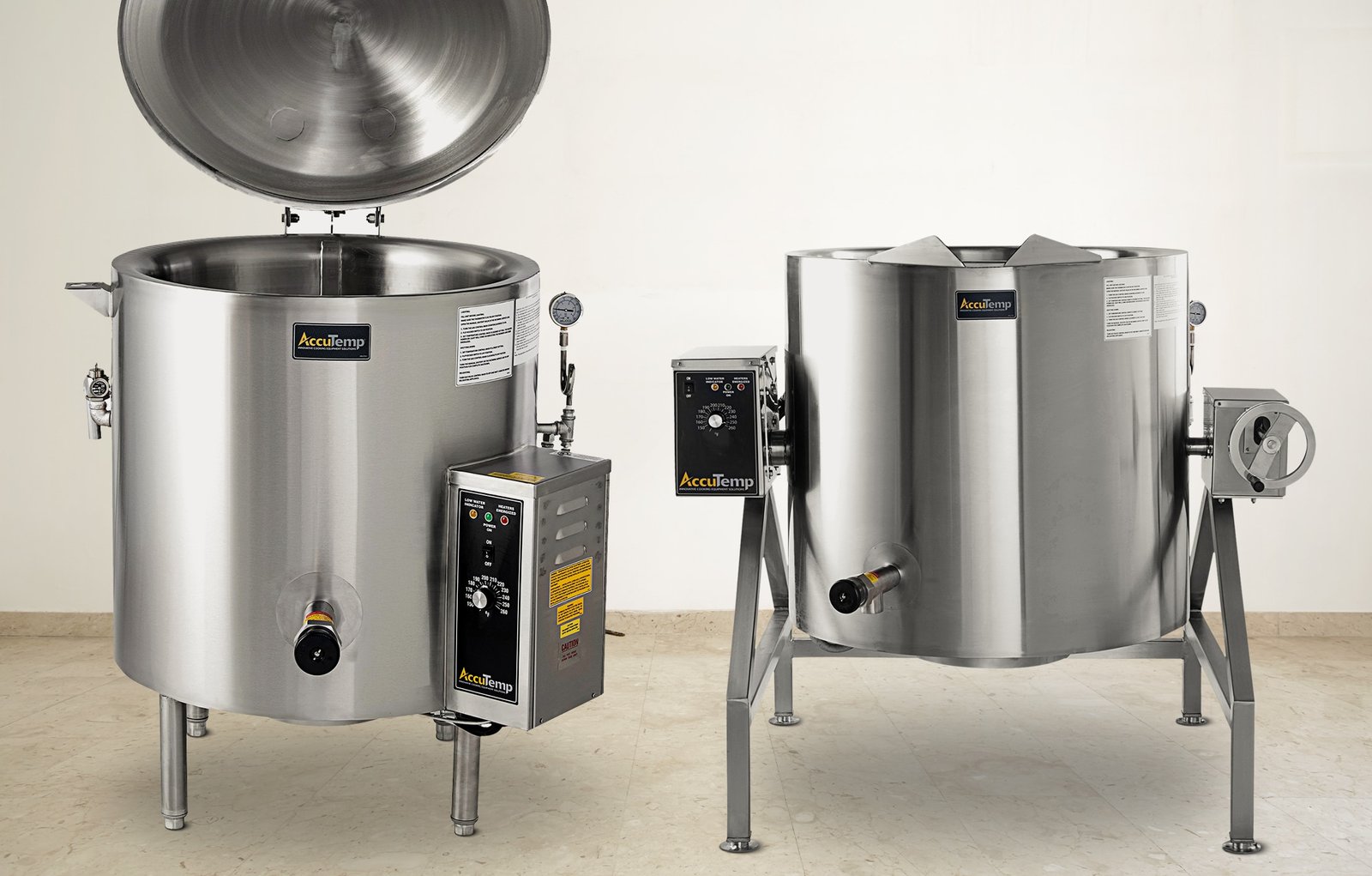
The institutional market has shifted toward equipment designed specifically for no-downtime operation. Traditional kettles from brands like Cleveland Range and Groen prioritize flexibility; specialized models like AccuTemp’s Edge Series prioritize reliability and consistent performance under heavy daily use.
Where Edge Series Outperforms: Measurable Differences
AccuTemp’s Edge Series uses a 360°-encircling steam jacket (vs. the standard 2/3-jacket design found in many competitive models) that creates more uniform heat distribution. This matters in institutional settings where consistency is non-negotiable.
Here’s what the performance data shows:
Temperature Stability During Extended Hold:
- Standard kettle (2/3 jacket): Temperature fluctuates ±4°F during a 4-hour hold period
- Edge Series (full/high-coverage jacket): Temperature fluctuates ±1.5°F during the same hold period
For HACCP documentation, this means fewer temperature log variations and simpler compliance verification. Staff don’t need to make manual temperature adjustments mid-shift—the equipment maintains setpoint automatically.
Heating Speed for Batch Transitions:
- Blanching 30 gallons of water to rolling boil in a 40-gallon Edge skillet: approximately 45 minutes
- Time to recover setpoint temperature after inserting cold ingredient: 8–10 minutes (vs. 12–15 minutes for standard tilts)
This 25% faster recovery time matters when you’re running 5–6 batches during a lunch shift. Over a school year, that’s 40–50 hours of recovered kitchen time.
How the Edge Control System Reduces Staff Training Time
Institutional kitchens have high staff turnover. Seasonal workers, substitutes, and recent hires mean your equipment must be intuitive. The Edge Series uses a single digital control knob (not traditional Cleveland’s multi-dial interface) and a preset-programming system that eliminates math errors.
Example workflow:
- Cleveland Range kettle: “Dial to 200°F, watch the analog gauge, adjust manually if temperature drifts”
- AccuTemp Edge: “Press ‘3’ for soup preset (160°F holding temp), equipment automatically locks at critical control point, alarms if temp drops”
For a high-turnover kitchen where 30% of staff changes annually, this interface simplicity reduces training time by 4–6 hours per employee per year. Multiply across a 20-person facility: that’s 80–120 hours of supervisor time freed up.
Maintenance Intervals: Where Durability Becomes ROI
AccuTemp equipment uses self-lubricating gears in tilt mechanisms, reducing the “scheduled maintenance” that other skillets demand. Where a traditional tilt requires monthly greasing of the tilt rod and quarterly bearing inspection, Edge Series requires annual inspection only.
The financial impact: Preventive maintenance costs approximately 50% less than emergency repairs. A tilt mechanism that fails mid-service requires after-hours emergency service (typically $1,500–$2,500 in labor and travel fees). Annual preventive maintenance costs $300–$500.
Spare parts strategy for Edge Series:
- Stock: Pressure relief valve ($150), thermostat ($200), removable gaskets ($75)
- Average replacement cost if failure occurs: $425
- Emergency service call if you’re unprepared: $2,000
- Downtime cost per hour (lost meal service): $500–$800
Where Edge Series Isn’t Necessary (Budget-Conscious Procurement)
For satellite kitchens or low-volume operations (under 200 meals/day), a standard steam kettle from Cleveland, Groen, or Vulcan delivers adequate performance at 15–20% lower cost. The Edge Series ROI only appears at 500+ meals/day.
Right-size your budget: Don’t over-specify equipment. A school with one kitchen serving 400 lunches daily doesn’t need Edge Series. A district central kitchen processing 3,000+ meals daily absolutely does.
Tilt Skillets vs. Traditional Kettles: Labor Savings by the Numbers
Tilt skillets introduced a paradigm shift in institutional kitchens—they eliminate the labor-intensive task of manually draining or ladling large batches. But they’re not universally cost-effective. Understanding which recipes justify the premium is critical.
Labor Reduction: Quantified Across Real Workflows
A case study from a mid-sized school district kitchen in the Midwest compared labor hours before and after acquiring a 40-gallon tilt skillet:
Before (using traditional stationary kettles and stock pots):
- Braising greens: 2 staff members × 35 minutes = 70 labor-minutes per batch
- Pasta production: 2 staff members × 40 minutes = 80 labor-minutes per batch
- Sauce reduction: 1 staff member × 45 minutes = 45 labor-minutes per batch
- Weekly total for these three recipes: 11 hours of labor
After (using 40-gallon tilt skillet):
- Braising greens: 1.5 staff members × 20 minutes = 30 labor-minutes per batch
- Pasta production: 1.5 staff members × 22 minutes = 33 labor-minutes per batch
- Sauce reduction: 1 staff member × 25 minutes = 25 labor-minutes per batch
- Weekly total for these three recipes: 1.5 hours of labor
Labor hours saved: 9.5 hours per week, or 437 hours annually at an average wage of $18/hour = $7,866 annual labor savings.
A 40-gallon tilt skillet carries a total cost of ownership (equipment + installation + training) of approximately $24,000. Payback period: 3 years. After year 3, it’s pure operational savings.
The Operational Drawback: Why Tilt Skillets Fail for Soup
The tilt mechanism introduces splashing and foaming—manageable for thick sauces and braised vegetables but disastrous for soup. When you tilt a kettle filled with 30 gallons of hot broth, surface tension breaks and liquid splashes across the kitchen floor, creating both food safety hazards and worker safety risks.
Additionally, soup’s lower viscosity means it drains faster than you can control with a manual tilt. Strainer baskets overflow. You end up pouring the remainder into secondary containers anyway—negating the labor advantage.
When to use tilt skillets:
- Sauces with viscosity (gravies, cream bases)
- Braised vegetables (greens, root vegetables)
- Pasta and grains (reheating, batch assembly)
- Braising meat (beef stew, chicken stew)
When to use traditional kettles:
- Stocks and broths
- Soups (tomato-based, vegetable, cream)
- Batch soups requiring holding at 160°F+ for 2+ hours
- Recipes requiring precise temperature control without agitation
Tilt Mechanism Cost-Benefit: Upfront vs. Long-Term
A standard 40-gallon steam kettle costs $20,000–$24,000. Adding the tilt mechanism adds $3,500–$5,500 to the purchase price. For a kitchen producing 5–6 tilt-suitable batches per week, payback happens within 14–18 months of labor savings. For a kitchen using the tilt feature 1–2 times weekly, payback extends to 5+ years, making the investment marginal.
Decision framework:
- Calculate weekly batch production for tilt-suitable recipes
- Multiply by labor hours saved per batch (typically 10–15 minutes)
- Multiply by your average wage rate
- Divide equipment cost by annual savings to get payback period
- If payback exceeds 4 years, invest in a standard kettle instead
The Hidden Budget Killer: Energy & Water Consumption Benchmarks
Utilities often consume 12–18% of foodservice operational budgets, yet equipment selection rarely reflects this reality. A $20,000 kettle purchase decision ignores the $1,200–$1,800 in annual utility costs running alongside it.
Water Usage: The Overlooked Efficiency Metric
Steam-jacketed kettles reduce water consumption by approximately 18% compared to direct-heated models because the insulated jacket maintains temperature longer between batches. A 40-gallon kettle operating 250 days/year tells this story:
| Kettle Type | Gallons/Hour (Idle) | Annual Waste | Cost @ $8/1000 gal |
|---|---|---|---|
| Direct electric | 1.8 gal/hr | 450 gallons | $3.60 |
| Electric steam-jacketed | 0.6 gal/hr | 150 gallons | $1.20 |
| Gas steam-jacketed | 0.5 gal/hr | 125 gallons | $1.00 |
Multiply this across a 300-bed hospital with 6 kettles running during service hours, and you’re looking at $7,200–$10,800 in annual water heating costs. Over 10 years, that’s $72,000–$108,000 in cumulative waste.
5-Year Cost Projection: A $60,000 Decision That Looks Like $20,000
When a district CFO sees a steam kettle quote, they see the equipment cost. They don’t see the hidden costs that exceed the equipment purchase by 200% over the asset’s lifespan.
Realistic 5-year total cost of ownership for a 40-gallon steam kettle:
| Category | Year 1–5 Cost |
|---|---|
| Equipment purchase | $22,000 |
| Installation | $2,500 |
| Annual utilities (gas) | $6,000 |
| Maintenance (preventive) | $2,500 |
| Repairs (seal replacement, valve service) | $1,500 |
| Spare parts inventory | $800 |
| Total 5-year cost | $35,300 |
Cost per meal produced (assuming 400 meals/day, 250 service days/year = 100,000 meals over 5 years): $0.35 per meal in equipment + operating costs.
ENERGY STAR Rebates: Up to $5,000 in Free Money (That Most Operators Miss)
Twenty-six states offer rebates for ENERGY STAR-certified commercial kitchen equipment. The rebate structures vary, but they typically cover 30–50% of the equipment cost, capped at $5,000 per unit.
Who qualifies:
- Non-residential foodservice facilities (schools, hospitals, corporate dining)
- Equipment must be ENERGY STAR-certified at time of purchase
- Installation must occur within the specified program year (usually calendar year)
- Individual rebate capped at 50% of equipment cost
How to capture these dollars:
- Check your state’s energy utility website for the Commercial Kitchen Equipment rebate program (usually found under the “Small Business” or “Commercial Incentives” section)
- Request ENERGY STAR certification documentation from the equipment manufacturer before purchase
- Submit the rebate application before the equipment is installed (most programs require pre-approval)
- Provide purchase invoice and installation documentation within 30 days
Example: A Pennsylvania school district purchasing a $22,000 ENERGY STAR-certified kettle qualifies for a $5,000 rebate (Pennsylvania Department of Energy & Environment Commercial Kitchen Program). Net cost: $17,000. Annual utility savings: $800–$1,200. Payback period: 14–17 years (acceptable for a capital asset with 15–20 year lifespan).
Extending Kettle Lifespan: Maintenance Protocols That Actually Work
Equipment failure isn’t random—it follows predictable failure modes. Understanding the top three causes of premature kettle failure (leaking seals at 47%, scale buildup at 33%, and sensor drift at 20% of cases) lets you prevent 80% of common problems through simple preventive protocols.
Monthly Deep-Clean Checklist: The 15-Minute Routine That Saves $2,000
Run this procedure at month-end or during low-service periods. It takes 15 minutes and prevents 90% of seal failures:
Monthly Deep-Clean Protocol:
- Drain and cool the kettle to room temperature (or cool to 120°F minimum)
- Inspect the drain valve assembly:
- Remove the strainer basket and inspect for debris accumulation
- Run hot water through the drain line to flush calcium deposits
- Check rubber gasket around drain valve for cracks or discoloration
- Red flag: If gasket is brittle or cracked, order replacement (cost: $75; wait: 3–5 days)
- Inspect pressure relief valve:
- Activate the manual test lever (the little handle that pops up when you push it)
- Water should spray from the overflow line into the drain
- Red flag: If no water sprays, the valve is stuck and must be replaced immediately
- Wipe the kettle interior with a soft cloth and mild detergent
- Look for white chalky deposits (scale buildup) on the bottom and sides
- If scale is visible, add 2 gallons of white vinegar and 4 gallons of hot water, let sit for 2 hours, then drain
- Check the temperature gauge:
- The display should match a handheld thermometer placed against the kettle exterior (within ±3°F)
- Red flag: If variance exceeds ±5°F, the thermostat is drifting and needs recalibration or replacement
Zero-Downtime Strategy: Spare Parts Inventory Guide
Institutional kitchens can’t afford to wait for parts. Build a small spare parts library stored on-site:
Must-Have Backup Components (Order 2 of each):
- Thermostat assembly ($150–$200 each): The most common failure point; digitally controlled units fail faster than analog in high-humidity kitchens
- Pressure relief valve ($120–$180 each): Wear out under repeated cycling; stock two to ensure continuous operation during replacement
- Removable gaskets/seals (set of 3, $75 per set): Elastomer degradation is predictable; replace annually as preventive maintenance
- Pressure gauge ($40–$60 each): Mechanical gauges lose accuracy; keep backup for rapid replacement without shutting down equipment
Nice-to-Have Components (Order 1 of each):
- Drain valve body assembly ($200–$300)
- Tilt handle/crank replacement kit ($150–$250, for tilting skillets)
- Control panel gasket ($50–$75)
Spare parts cost: $600–$900 upfront, spread across your equipment lifespan. Downtime prevention value: $2,000–$3,000 in lost meal service avoided by having parts on-hand.
AccuTemp’s Removable Gasket Advantage vs. Vulcanized Competitors
This design difference matters for long-term maintenance cost. Traditional kettles from some manufacturers vulcanize (permanently bond) gaskets to the kettle body during manufacturing. When gaskets degrade (typically after 24–36 months of continuous use), you must order a gasket assembly, disassemble half the kettle, and wait 5–7 days for parts.
AccuTemp Edge Series uses removable, field-replaceable gaskets that snap into place. Replacement is a 5-minute task requiring no special tools. Annual gasket replacement costs $75 and takes less time than your monthly deep-clean routine.
Over 10 years, this design difference saves:
- 3 emergency service calls (24 hours downtime each) = 72 lost meal service hours
- 3 expedited shipping charges for emergency parts = $450 in shipping costs
- Labor time for disassembly/reassembly = 12 hours at $35/hr = $420
Total design advantage for removable gaskets: $2,000+ over the kettle’s lifespan.
Institutional Compliance Checklist: NSF/ANSI 4 Verification Sheet
Before finalizing any steam kettle purchase, download and complete this NSF compliance verification form with your equipment vendor:
Essential Questions to Ask the Manufacturer:
- Is your kettle NSF/ANSI 4 certified? (Require certificate number, not just the claim)
- What is the NSF certificate expiration date? (Certifications lapse; ensure it’s current)
- Are all food-contact surfaces 316 stainless steel or NSF-approved alternative? (Confirm in writing)
- Is the drain valve front-facing and removable for cleaning without disassembly?
- What is the temperature sensor accuracy rating? (Should be ±2°F or better for institutional use)
- Are gaskets/seals removable and field-replaceable? (Not vulcanized or permanently bonded)
- Does the equipment include a temperature data logging system or printable log sheets?
- What is the scheduled maintenance interval? (Should be annual or longer for institutional-grade equipment)
- Are spare parts available within 3–5 business days for critical components?
Red flags that should eliminate a vendor from consideration:
- “Our kettles are Food Service Grade” (vague language, not NSF certification)
- “NSF certification is available upon request” (it should be provided immediately)
- Drain valve is bottom-mounted or requires partial disassembly to access
- Gaskets are welded or glued in place
- Temperature accuracy is ±5°F or worse
- Maintenance intervals exceed quarterly
5-Year Cost of Ownership Calculator
Use this framework to calculate true operating costs for your facility. Plug in your specific utility rates, production volume, and maintenance assumptions:
Custom 5-Year Projection Tool:
Equipment Cost: ________________
Installation: ________________
Annual Energy (Gas): ________________
Annual Energy (Electric): ________________
Annual Water/Sewer: ________________
Maintenance per year: ________________
Expected lifespan: __________ years
Calculation:
- Total 5-year cost = Equipment + (Annual Energy × 5) + (Maintenance × 5)
- Cost per meal = Total 5-year cost ÷ (Daily meals × Service days/year × 5 years)
Example for hospital foodservice (300-bed facility, 600 meals/day, 365 service days/year):
- Equipment: $22,000
- Installation: $2,500
- Annual energy (gas): $1,200 × 5 = $6,000
- Annual maintenance: $500 × 5 = $2,500
- Total 5-year cost: $33,000
- Total meals produced: 600 × 365 × 5 = 1,095,000
- Cost per meal: $0.03
Tilt Skillet Decision Matrix: Recipe-Based Workflow Tool
Not every recipe benefits from tilt-skillet efficiency. Use this tool to determine which items in your menu would justify the equipment investment:
| Recipe Type | Batch Size | Manual Drain Time | Tilt Drain Time | Labor Savings | Frequency/Week | Annual Benefit |
|---|---|---|---|---|---|---|
| Pasta (dry goods) | 30 lb | 15 min | 5 min | 10 min | 3× | $1,170 |
| Braised greens | 20 lb | 20 min | 8 min | 12 min | 2× | $624 |
| Sauce reduction | 10 gal | 12 min | 4 min | 8 min | 3× | $936 |
| Soup | 30 gal | Unsuitable—splashing hazard | — | — | — | — |
| Stock | 40 gal | 18 min | Unsuitable—splashing hazard | — | — | — |
| Braised meat | 25 lb | 15 min | 6 min | 9 min | 2× | $468 |
| WEEKLY TOTAL LABOR SAVINGS | $3,198 annually |
If your tilt-suitable recipes equal less than 2 hours weekly labor savings (approximately $2,000 annually), the tilt mechanism doesn’t meet the ROI threshold.
Next Steps: Moving from Planning to Purchase
Step 1: Document Your Specifications
Complete the batch production worksheet and institutional compliance checklist above. Share these documents with your procurement team. Having one-page spec sheets cuts vendor response time from 3 weeks to 3 days.
Step 2: Request ENERGY STAR Certifications Upfront
Before requesting pricing, ask vendors to provide ENERGY STAR documentation. This single step unlocks $2,000–$5,000 in state rebates that most buyers never access.
Step 3: Verify NSF Certification in Writing
Call the manufacturer directly and request NSF/ANSI 4 certificate numbers. Visit nsf.org and search the NSF Product Listings database to confirm the certificate is current and covers the exact model you’re considering. A 10-minute verification step prevents purchasing non-compliant equipment.
Step 4: Pilot Maintenance Protocols with Your Current Equipment
Before committing to new equipment, practice the monthly deep-clean routine on your existing kettle. This gives your team confidence in the procedures and reveals any facility-specific challenges (drain access, water hardness, etc.) that should influence your next equipment selection.
Step 5: Develop a Spare Parts Procurement Plan
Identify the three–four critical components that fail most frequently in your operating environment. Pre-order spares from your vendor before the equipment arrives. Backup parts sitting on a shelf cost $600 today but save $2,000–$3,000 in emergency downtime costs.
Some Useful Resources
Manufacturer Resources:
- AccuTemp Edge Series Product Specification Sheet – Classic model specifications and features
- AccuTemp Downloads Center – Access product manuals, spec sheets, installation guides, and owner’s manuals
Market Intelligence:
- Data Bridge Market Research: Global Foodservice Equipment Market – Growth trends, smart kitchen technology adoption, and IoT integration forecasts (5% CAGR through 2032)
- Market Research Future: Commercial Kitchen Equipment Market – Analysis of energy efficiency trends, food safety standards, and institutional demand drivers ($100.27B projected by 2035)
- IMARC Group: Food Service Equipment Market Forecast – IoT market integration, cloud-based systems, and sustainability trends ($59.6B projected by 2033)
- Fortune Business Insights: Institutional Food Service Market – School, hospital, and healthcare foodservice trends; therapeutic nutrition and digital technology adoption ($543.14B market size in 2024)
Industry Standards & Compliance:
- NSF International Food Equipment Standards Database: www.nsf.org (search “NSF/ANSI 4 certified products”)
- ENERGY STAR Commercial Kitchen Equipment: www.energystar.gov/products (filter by steam kettles and cookers)
- FDA Hazard Analysis and Critical Control Point (HACCP) Guidelines: www.fda.gov/food/hazard-analysis-critical-control-point-haccp/haccp-principles-application-guidelines
- USDA National Food Service Management Institute (NFSMI): www.usda.gov/taxonomy/term/6278
SAH Kitchen Equipment Resources:
- Commercial Kitchen Equipment TCO Calculator
- Cloud Kitchen Multi-Brand Throughput Calculator
- Commercial Kitchen Order Staging & Hot-Holding Planner
- Commercial Kitchen Peak Order Wave Analyzer
- Want the complete 72-point checklist covering every validation step, specification template, and vendor evaluation scorecard? Get your Commercial Kitchen Equipment Procurement Checklist for the comprehensive planning tools that prevent the $10,000+ mistakes we’ve documented in under-planned equipment projects.
Must Also Read
- Commercial Kitchen Equipment Buying Guide: Avoid Costly Mistakes & Maximize ROI (2025-2026 Updated)
- The Culinary Leader’s Rational Combi Oven Buying Guide: Maximize ROI & Consistency
- Bizerba Commercial Scales Buying Guide: Choose the Right Model for Compliance & Efficiency
- Essential Cloud Kitchen Equipment: Maximizing Output in Under 500 Sq Ft (2025-2026 Guide)